Originally published: 31 July 2025
Last updated: October 2026
Quick answer:
Local SEO is how a business gets found when people nearby search for what it offers, such as electrician Kilmarnock or accountant near me. For Ayrshire businesses it comes down to five things: a complete and active Google Business Profile, a website with a clear page for each main service and the towns you genuinely serve, consistent business details across the web, a steady flow of genuine reviews, and links and mentions from other local organisations. Google ranks local results on relevance, distance and prominence, so you cannot change where a searcher is, but you can make your business the most relevant and most trusted option near them.
Who this guide is for
This guide is for businesses in East, North and South Ayrshire, and nearby Glasgow, that rely on local customers: trades, shops, clinics, hospitality, professional services and anyone with a service area. It brings together several earlier articles on local SEO, homepage optimisation for Kilmarnock, common local SEO mistakes, SEO for Glasgow trades and semantic SEO, so everything is in one place.
Every step is something you can check or do yourself. Where it helps, examples use Ayrshire towns such as Kilmarnock, Ayr, Irvine, Troon, Prestwick, Largs, Cumnock and Stewarton.
How local search results work
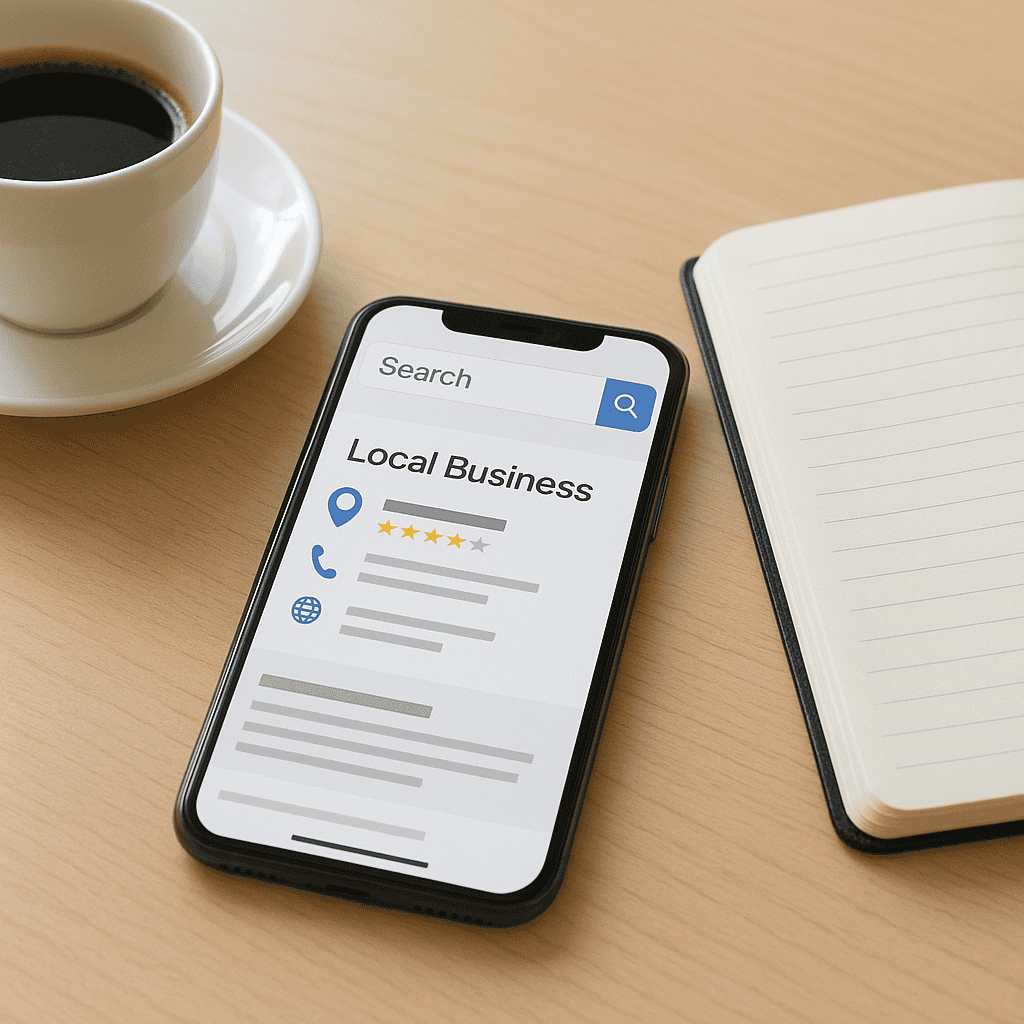
When someone searches for a local service, Google usually shows two kinds of result:
- The map pack: a map with three businesses underneath, drawn from Google Business Profiles. On a phone this often fills the whole first screen.
- The organic results: the normal list of web pages below it, drawn from websites.
Google says it ranks local results on three things:
| Factor | What it means | What you can do |
|---|---|---|
| Relevance | How well your business matches the search | Choose the right categories, list every service, write clear service pages |
| Distance | How far you are from the searcher or the place they named | Set accurate service areas, create pages for towns you genuinely serve |
| Prominence | How well known and trusted your business is | Earn reviews, local links and mentions, keep your website strong |
Distance is the one you cannot change. A plumber based in Kilmarnock will rarely top the map pack for a search made in Largs. That is why your website matters as much as your profile: a strong page about the service in that town can still rank in the organic results.
Step 1: Set up your Google Business Profile properly
Your Google Business Profile is the foundation of local SEO. Check each of these:
- Business name exactly as it appears on your signage and paperwork. Adding keywords or towns to the name breaks Google’s guidelines and can get the profile suspended.
- Primary category that describes your main service as specifically as possible, for example Kitchen remodeler rather than Contractor. Add secondary categories only where they genuinely apply.
- Address or service area. If customers visit you, show the address. If you travel to them, set a service area by town or council area and hide the address.
- Phone number and website that match your website exactly.
- Services and products listed individually with short descriptions.
- Opening hours, including holiday hours.
- Photos of real work, your team, vehicles and premises, added regularly.
- Posts at least every couple of weeks: recent jobs, offers, seasonal advice.
Our guide on why a Google Business Profile isn’t ranking covers profile optimisation in depth, and Google Maps ranking in Glasgow looks at competing in the map pack in a busy city.
Step 2: Make your website clearly local
Your homepage
For many small businesses the homepage is the page that ranks for the most important local search. Within the first screen, a visitor and Google should be able to see:
- What you do, in plain words, in the main heading. For example: Electrician in Kilmarnock and East Ayrshire.
- The main towns or area you cover.
- Your phone number as a tap-to-call link and a clear call to action.
- Proof: review rating, years trading, accreditations.
Set the homepage title tag along the same lines, such as Electrician in Kilmarnock | Smith Electrical, and include your business name, address and phone number in the footer of every page.
One page for each main service
Create a separate page for each service you want to be found for, rather than listing everything on one page. A roofer might have pages for roof repairs, new roofs, flat roofs, guttering and chimney work. Each page should explain the service, typical jobs, prices or how pricing works, areas covered, photos and reviews relating to that service, and how to get a quote.
Town pages only where you have something to say
Pages for individual towns can help you appear in searches such as roofer Ayr or roofer Irvine, but only if each page is genuinely useful. Include jobs you have done in that town, how quickly you can get there, local considerations and reviews from local customers. Pages that are identical apart from the town name are treated as low quality and are often left out of Google’s index entirely.
Add local business schema
Schema markup tells Google your business details in a structured way. Most SEO plugins, including Rank Math, can add LocalBusiness schema with your name, address, phone number, opening hours and service area. Make sure the details match your Google Business Profile exactly.

Step 3: Keep your business details consistent
Google cross-checks your name, address and phone number (often called NAP) across the web. Inconsistencies, such as an old address on a directory or a different phone number on Facebook, weaken trust in your details.
- Decide on one exact format for your name, address and phone number and use it everywhere.
- Check and update the main listings: Google, Bing Places, Apple Business Connect, Facebook, Yell, Thomson Local and relevant trade or professional bodies.
- Add your business to genuinely relevant local and industry directories rather than hundreds of low-quality ones.
- If you have moved or changed number, search for your old details and correct every listing you find.
Step 4: Build a steady flow of reviews
Reviews affect both your ranking in the map pack and whether people choose you once they see you. What matters:
- Ask every happy customer, ideally when the job is finished and they are pleased. Send a direct link to your review form by text or email.
- Keep them coming. A few new reviews every month looks better to customers than a burst two years ago.
- Reply to every review within a few days, mentioning the service and, naturally, the town where relevant.
- Never buy reviews or offer rewards for them. Both break Google’s policies and can lead to reviews being removed or the profile being restricted.
Our guide to getting better Google Business Profile reviews has templates and a simple process.
Step 5: Earn local links and mentions
Links from other local websites are one of the strongest signals that a business is established in an area. Practical ways for Ayrshire businesses to earn them:
- Membership of local business organisations such as Ayrshire Chamber of Commerce, with a profile that links to your website.
- Sponsoring local sports clubs, events or charities that list sponsors on their website.
- Supplier and partner pages, for example a builder listing the electrician they use.
- Local news coverage of a notable project, milestone or community activity.
- Case studies written with, or for, local clients who are happy to link back.
Step 6: Write content that covers the whole topic
Google increasingly understands topics and the relationships between things, not just matching words. This is sometimes called semantic SEO. For a local business it means a service page that answers the questions customers actually ask will usually outrank one that repeats the keyword.
For a boiler installation page, that might mean covering boiler types, typical costs, how long installation takes, finance options, guarantees, which brands you fit, whether you remove the old boiler, and the areas you cover. Look at the People also ask box in Google and at the questions customers ask you on the phone. Each is a section waiting to be written.
One good page per topic is better than several thin ones. If you have published several similar articles, combine them into one stronger page and redirect the old addresses, which is exactly what we have done with this guide.

Common local SEO mistakes
| Mistake | Why it hurts | Fix |
|---|---|---|
| Keywords stuffed into the business name on Google | Breaks Google’s guidelines and risks suspension | Use your real trading name |
| Wrong or vague primary category | You do not appear for your main service | Choose the most specific category for your main service |
| Homepage that does not say what you do or where | Google and visitors cannot tell what the business offers | Service and area in the main heading and title tag |
| All services on one page | No page is strongly relevant to any single search | Create a page for each main service |
| Copied town pages | Seen as low quality and often not indexed | Write town pages only where you have local detail |
| Inconsistent name, address or phone number | Weakens trust in your details | Audit and correct directory listings |
| No reviews for months | Lower prominence and fewer clicks | Ask every happy customer, every time |
| Slow or awkward mobile site | Most local searches are on phones | Test on a real phone and fix speed first |
Step 7: Track the right numbers
- Google Business Profile performance: calls, website clicks, direction requests and the searches that found you.
- Google Search Console: filter queries by town names, such as Kilmarnock or Ayr, to see how you appear for local searches and which pages they land on.
- Google Analytics 4: enquiries from organic search and from your profile. Adding a tracking parameter to your profile’s website link lets you separate profile traffic from other search traffic.
- Ask every new customer how they found you and keep a simple tally.
Local SEO builds over months. Profile changes and new reviews can show results within weeks, while new pages and links usually take two to three months to have a clear effect.
A 90-day local SEO plan
| When | What to do |
|---|---|
| Weeks 1 and 2 | Complete every section of your Google Business Profile. Fix your homepage heading and title tag. Add name, address and phone number to the website footer. |
| Weeks 3 and 4 | Audit and correct your main directory listings. Set up a simple process to ask for reviews after every job. |
| Month 2 | Create or improve a page for each main service. Add LocalBusiness schema. Post on your profile every week. |
| Month 3 | Write town pages for the two or three areas where you do most work and have real local detail. Approach three local organisations about links or listings. Review the numbers. |
Getting help with local SEO in Ayrshire
Steve Welsh Marketing is based in Kilmarnock and works with businesses across Ayrshire and Glasgow. If you would like help with your Google Business Profile, website or local search visibility, see our Google Business Profile optimisation and SEO services in Ayrshire, or get in touch.
Questions
FAQs
-
What is local SEO?
Local SEO is the work that helps a business appear when people nearby search for its products or services, both in the Google map results and in the normal search results. It covers your Google Business Profile, your website, reviews, business listings and local links.
-
How does Google decide which local businesses to show?
Google ranks local results on relevance (how well you match the search), distance (how close you are to the searcher or the place they named) and prominence (how well known and trusted you are, shown by reviews, links and your website).
-
Do I need a separate page for every town I cover?
No. Create town pages only for areas where you do a lot of work and can include genuine local detail, such as jobs completed and local reviews. Pages that are identical apart from the town name are often treated as low quality.
-
How can I improve my homepage for local search?
State what you do and where in the main heading and title tag, show your phone number as a tap-to-call link, display reviews or other proof near the top, and include your business name, address and phone number in the footer.
-
How many Google reviews do I need?
There is no fixed number. Aim to get reviews steadily every month and to compare well with the businesses currently in the map pack for your main searches. Recent, detailed reviews carry more weight with customers than a large number of old ones.
-
Can I rank in towns where I do not have an address?
In the map pack it is difficult to rank far from your business location. In the normal search results you can rank for other towns with a strong, genuinely useful page about your service in that area, supported by local reviews and examples.
-
What are the most common local SEO mistakes?
Keyword-stuffed business names, the wrong primary category, homepages that do not say what you do or where, all services on one page, copied town pages, inconsistent business details across directories and long gaps between reviews.
-
How long does local SEO take?
Profile improvements and new reviews can make a difference within a few weeks. New pages, citations and links usually take two to three months to show a clear effect, and results keep building with steady work.

Steve Welsh is a digital marketing consultant and founder of Steve Welsh Marketing, helping businesses improve search visibility, attract better leads, and grow through practical, results-focused marketing.
More about Steve →