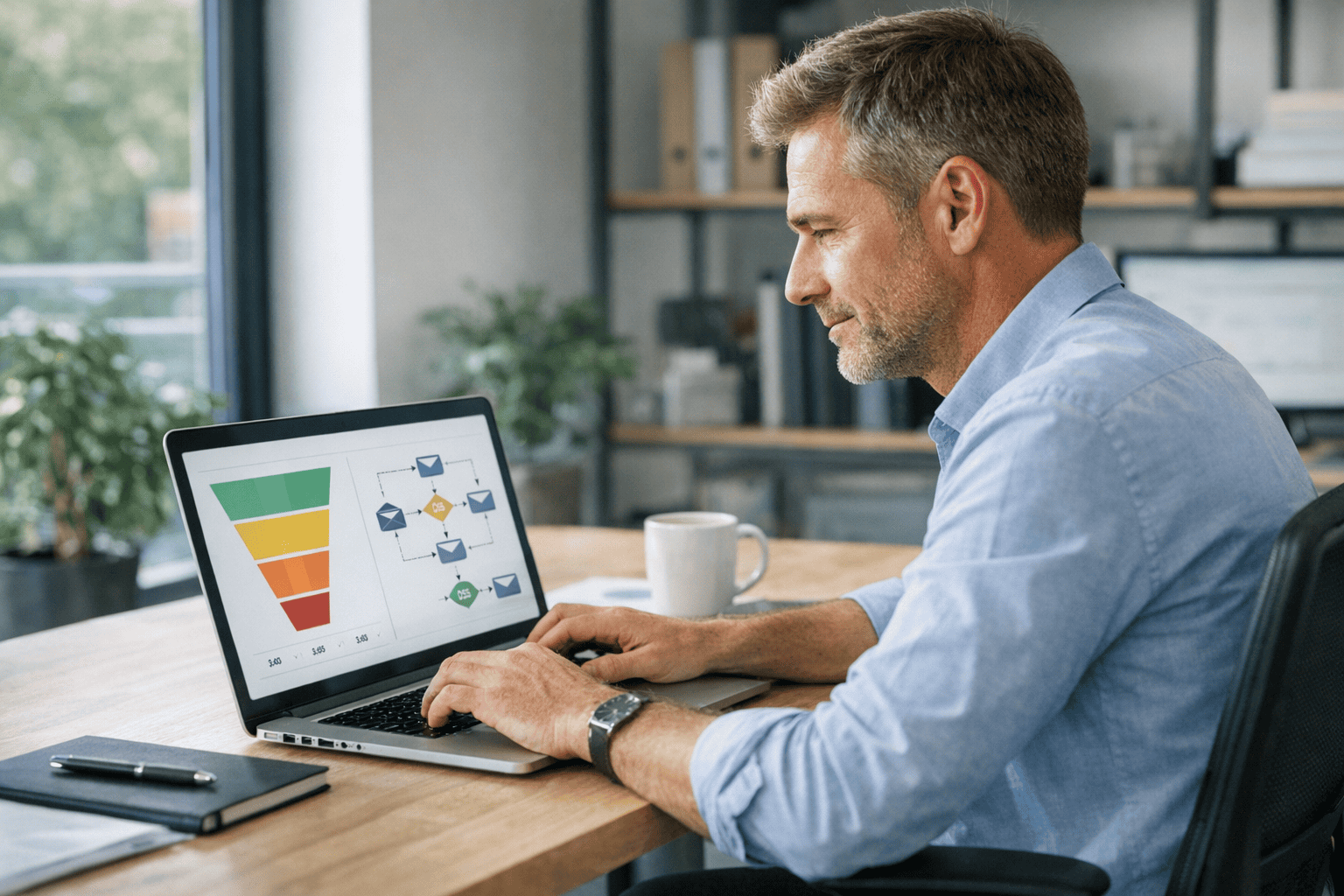
For many small businesses, growth is limited by time rather than demand. There are only so many hours in the day to answer enquiries, chase leads, send follow-up emails and move prospects towards a sale. That is where an automated sales funnel for small business growth becomes so valuable.
A well-built funnel helps you attract the right people, guide them through a clear buying journey and follow up consistently without relying on manual effort every time. Instead of losing leads because you were busy, forgot to reply or had no structured process in place, automation keeps your marketing moving in the background.
This does not mean removing the human element. It means using systems to handle repetitive tasks so you can focus on sales conversations, service delivery and strategic decisions. For UK business owners who want more leads, better conversion rates and less admin, a practical sales funnel strategy can make a real difference.
In this guide, you will learn what an automated sales funnel is, how it works, the stages involved, the tools you may need and the common mistakes to avoid. The aim is to help you create a small business sales funnel that is simple, effective and commercially useful.
What an automated sales funnel is and why small businesses need one
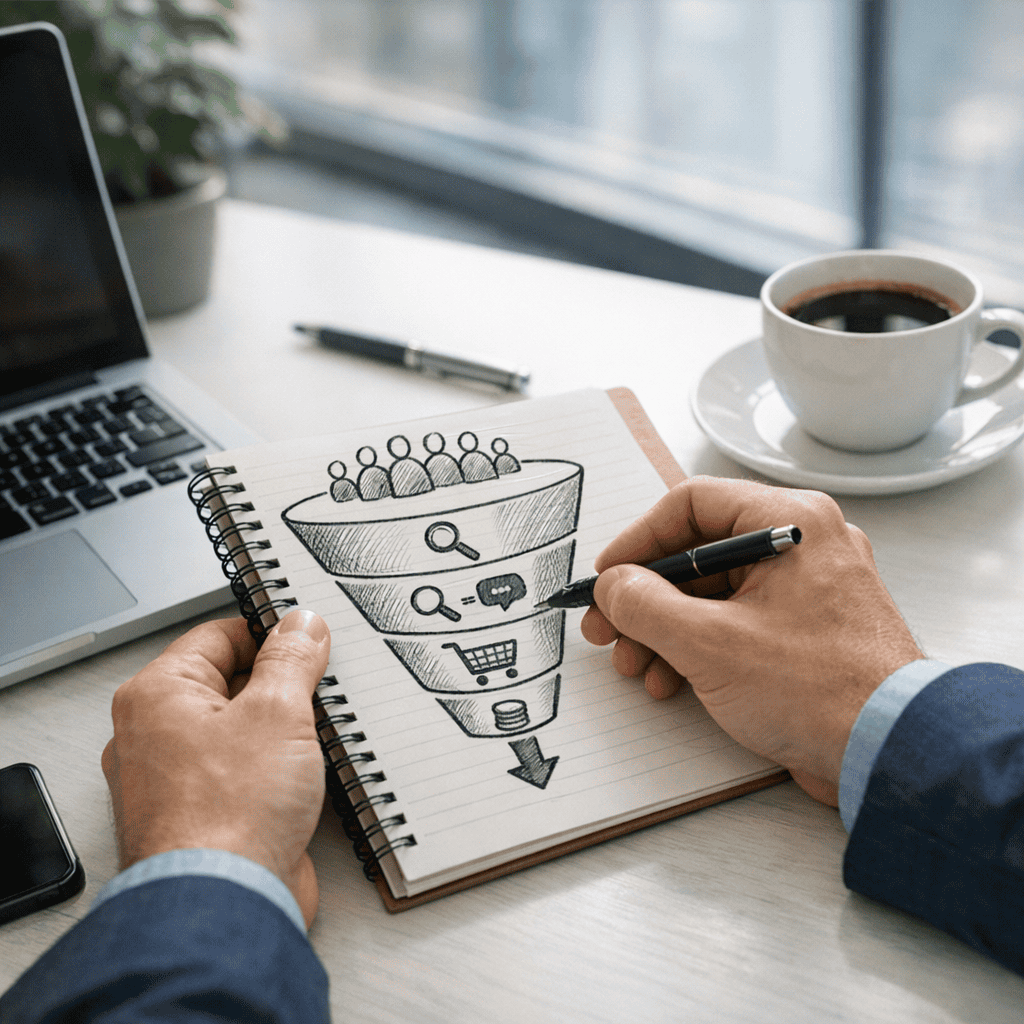
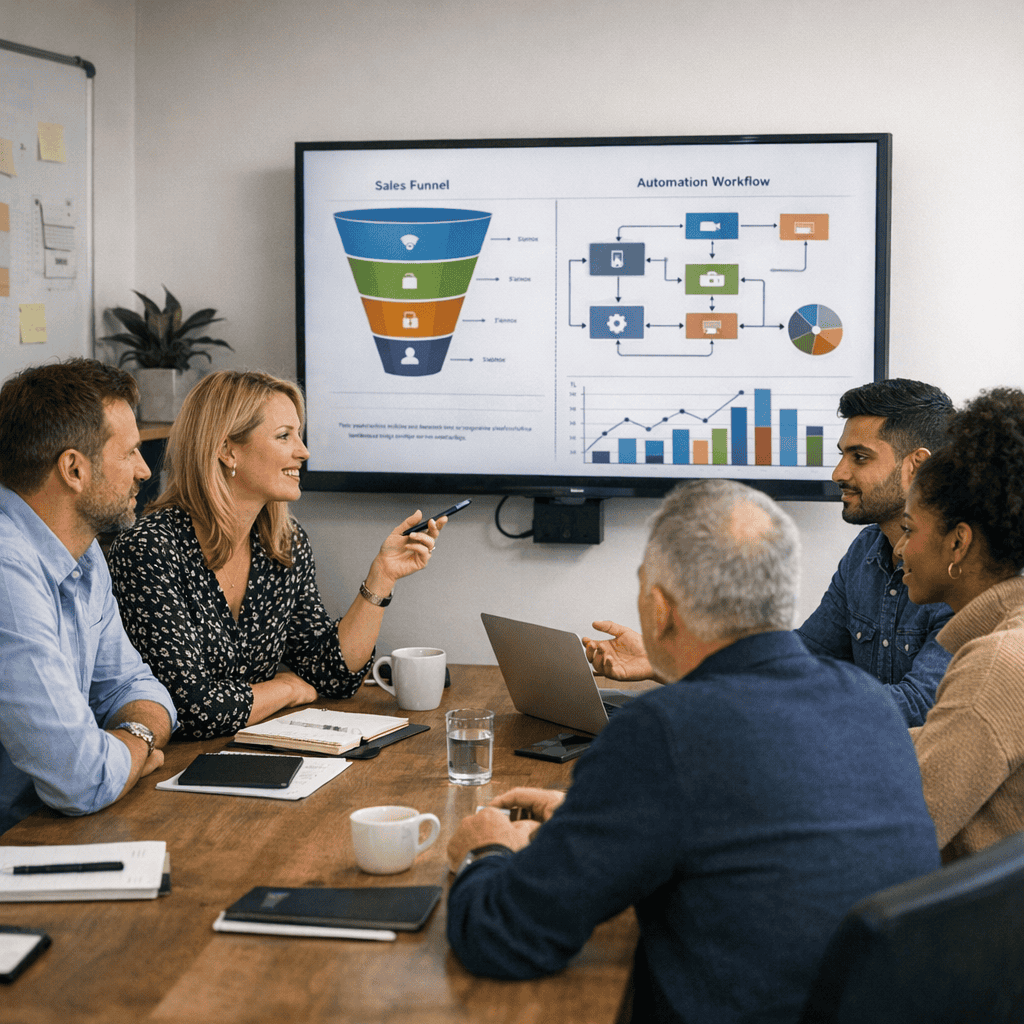
An automated sales funnel is a structured process that moves potential customers from first contact to purchase using a combination of content, landing pages, email follow-up, lead capture and automated actions. Rather than relying on ad hoc marketing, it gives you a repeatable system for lead generation and lead nurturing.
For a small business, this can be especially powerful because it reduces the need to manually manage every enquiry. It also improves consistency. Every lead receives the right message at the right stage, whether they come through your website, social media, paid ads or referrals.
A good funnel is not about pushing people into a sale. It is about helping them make a decision by giving them relevant information, building trust and making the next step clear.
How a sales funnel works from first enquiry to purchase
At a basic level, a sales funnel has several stages.
First, you attract attention. This might happen through search engine optimisation, Google Ads, social media content, a downloadable guide, a webinar, a free consultation or a useful blog post.
Next, you capture the lead. Instead of hoping someone remembers your business later, you give them a reason to share their details. That might be a quote request, a booking form, a downloadable checklist or a free audit.
Once they are in your system, the nurture stage begins. This is where an email nurture sequence often plays a key role. You send a series of useful, relevant messages that answer common questions, explain your offer, address objections and build confidence.
Then comes the conversion stage. This is where the prospect is encouraged to take a clear action such as booking a call, requesting a proposal, making a purchase or signing up for a service.
After the sale, the funnel can continue. You can automate onboarding, ask for reviews, encourage repeat purchases and introduce related services.
For example, a local accountancy firm might use a lead generation funnel offering a free tax checklist for small business owners. Once someone downloads it, they receive a sequence of emails covering tax deadlines, common mistakes and practical tips. The final emails invite them to book a consultation. That is a simple but effective automated process.
Why automation saves time and improves lead follow-up
One of the biggest problems in small business marketing is inconsistent follow-up. Leads come in, but responses are delayed. Prospects show interest, but no one checks back in. Opportunities are lost not because the service is poor, but because the process is weak.
Marketing automation for small business solves this by making follow-up immediate and reliable. When someone fills in a form, they can receive a confirmation email straight away. A day later, they can receive useful information. A few days after that, they can be invited to take the next step.
This matters because timing affects conversion rate. If a prospect is interested today, waiting a week to respond can mean losing them to a competitor. Automation helps you stay visible while interest is still high.
It also saves time by reducing repetitive tasks. Instead of writing the same email over and over, you create it once. Instead of manually moving contacts between spreadsheets, your CRM can track progress automatically. Instead of relying on memory, your system handles reminders and triggers.
For a small team, that efficiency can have a direct commercial impact.
The core stages of an automated sales funnel
Every automated sales funnel for small business use should be built around a clear customer journey. While the details vary by sector, most funnels include two core functions: attracting the right leads and nurturing them until they are ready to buy.
If either part is weak, the funnel underperforms. You can drive traffic all day, but if the offer is poor or the follow-up is weak, conversions will stay low. Equally, strong emails will not help if the wrong people are entering the funnel in the first place.
Attracting the right leads with content and offers
The first stage is attraction. This is where you bring relevant people into your world. The key word is relevant. More traffic is not always better if it is the wrong audience.
Start by identifying who you want to reach. Are you targeting local service clients, ecommerce buyers, B2B decision-makers or homeowners looking for a quote? Your messaging, channels and offer should match that audience.
Then create an entry point that gives people a reason to engage. Common examples include:
- Free consultations
- Downloadable guides
- Price calculators
- Case studies
- Email newsletters
- Free audits
- Product demos
- Limited-time offers
For a trades business, the offer might be a free home survey. For a consultant, it could be a downloadable planning guide. For a software company, it might be a demo request.
The content around this offer matters too. Blog posts, service pages, social content and ads should all lead naturally towards the next step. If your website gets traffic but gives visitors no clear action to take, you are missing opportunities.
A strong lead generation funnel usually includes:
- A specific audience
- A clear problem
- A relevant offer
- A simple landing page
- A short form
- A clear call to action
The simpler you make this stage, the more likely people are to convert.
Nurturing prospects until they are ready to buy
Not every lead is ready to purchase immediately. In fact, many are still researching, comparing options or trying to understand what they need. That is why lead nurturing is such an important part of a small business sales funnel.
This stage is about building trust and moving people closer to a decision. A well-planned email nurture sequence can do this effectively without requiring constant manual input.
For example, a five-email sequence might look like this:
- Email 1: Deliver the promised resource or confirm the enquiry
- Email 2: Share a useful tip or insight related to their problem
- Email 3: Explain your approach and what makes your business different
- Email 4: Provide proof such as testimonials, reviews or case studies
- Email 5: Invite them to book a call, request a quote or make a purchase
This sequence should feel helpful rather than pushy. The goal is to answer questions, reduce uncertainty and keep your business front of mind.
Segmentation can improve results further. If someone downloaded a guide on one service, they should receive follow-up related to that service, not generic messages about everything you offer. The more relevant the communication, the stronger the conversion rate tends to be.
How to build an automated sales funnel for small business step by step
Building a funnel does not need to be complicated. In fact, the best systems for small businesses are often the simplest. A focused funnel with one offer, one audience and one clear next step will usually outperform a messy setup trying to do too much.
If you are wondering how to build an automated sales funnel for small business growth, start with the basics and get them working before adding complexity.
Choose one clear offer and one conversion goal
The first step is to decide exactly what the funnel is meant to achieve. Too many businesses try to send people in multiple directions at once. They ask visitors to call, email, download, follow on social media and browse five services all on the same page. That creates confusion.
Instead, choose one offer and one conversion goal.
Your offer could be:
- A free consultation
- A quote request
- A downloadable guide
- A product trial
- A booked demo
- A low-cost introductory service
Your conversion goal should be the single action you want the prospect to take next.
For example:
- Book a discovery call
- Request a quote
- Download a guide
- Start a free trial
- Buy a starter package
Once that is clear, build the funnel around it. Every page, email and message should support that one goal.
It also helps to define the audience and the problem. A stronger example is:
Helping local business owners improve website leads with a free website review
That is much more effective than:
Learn more about our marketing services
Specificity improves response.
Set up email sequences, landing pages and follow-up actions
Once your offer and goal are clear, the next step is to build the assets and automation.
Start with a landing page. This should include:
- A clear headline
- A short explanation of the benefit
- A simple form
- A strong call to action
- Trust signals such as testimonials or credentials
Keep distractions low. If the page is designed to get a consultation booking, do not overload it with unrelated links.
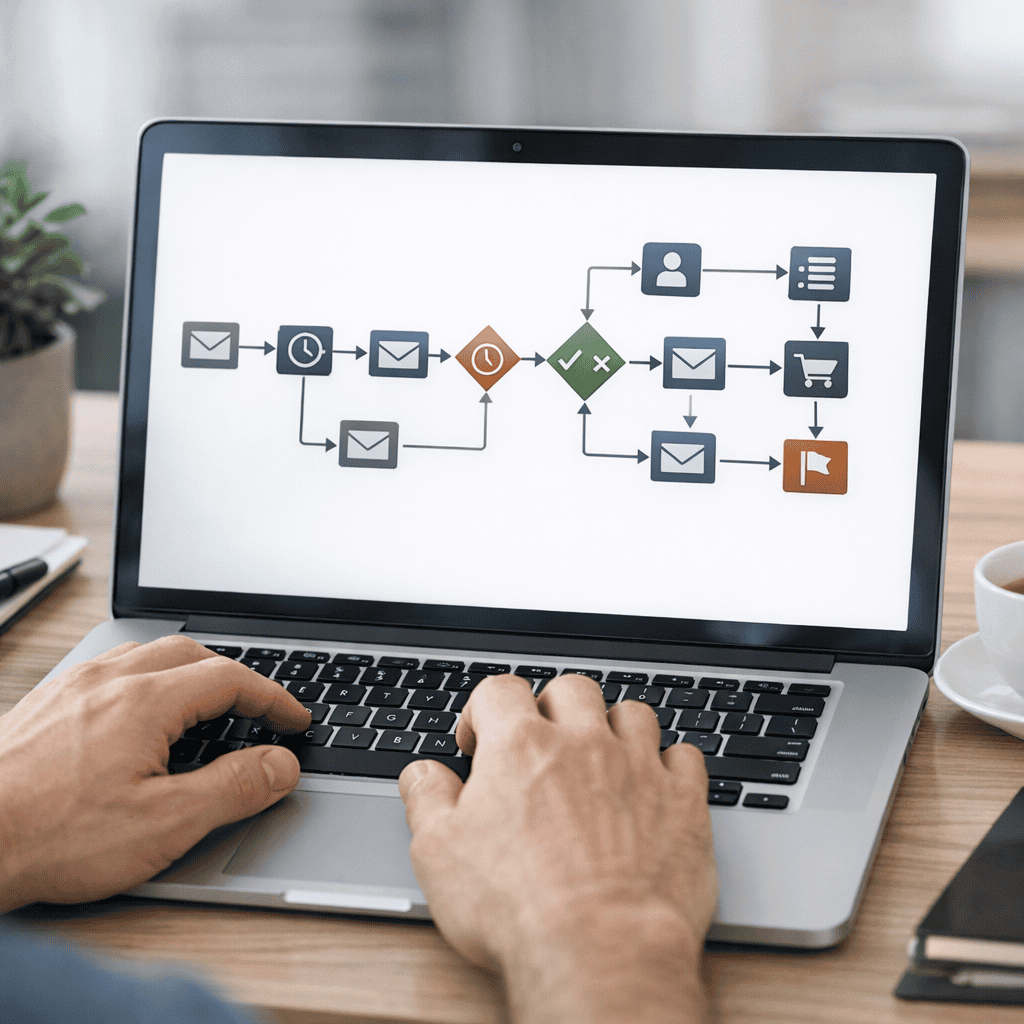
Next, connect the form to your email platform or CRM. When someone completes the form, trigger an immediate response. This could be:
- A thank-you email
- A booking confirmation
- Delivery of a downloadable resource
- A notification to your sales team
- A task created in your CRM
Then create your follow-up sequence. This should reflect the buyer journey. If someone requested a quote, your follow-up may focus on reassurance, process and proof. If they downloaded a guide, your follow-up may be more educational before moving towards a sales conversation.
You can also add actions such as:
- Tagging contacts based on interest
- Sending reminders if someone does not book
- Alerting your team when a lead reaches a certain score
- Moving contacts into a different sequence based on behaviour
For example, if someone clicks a pricing link in an email, that may indicate stronger buying intent. Your system could then trigger a more direct follow-up.
The key is to automate what is repetitive while keeping the experience relevant and useful.
Tools and systems that make automation manageable
You do not need an enterprise-level setup to create an effective automated sales funnel for small business use. Many small businesses can achieve excellent results with a few well-chosen tools connected properly.
The right setup depends on your budget, technical confidence and sales process. The aim is not to collect software. It is to create a system that is easy to manage and supports growth.
CRM, email marketing and landing page tools to consider
Most funnels rely on three core types of tools.
First, a CRM. This helps you track leads, record interactions, and manage pipeline stages. Popular options include HubSpot, Pipedrive, Zoho CRM and Capsule. A CRM is especially useful if your sales process involves calls, proposals or multiple touchpoints.
Second, an email marketing platform. This is where your automated email nurture sequence lives. Tools such as Mailchimp, ActiveCampaign, MailerLite and HubSpot can handle forms, automations and segmentation. The best choice depends on how advanced you need the automation to be.
Third, a landing page or website tool. This may be built into your website platform or handled through software such as Leadpages, Unbounce or your CRM system. The important thing is that you can create focused pages with clear calls to action and track conversions.
You may also use:
- Calendar booking tools such as Calendly
- Form builders
- Live chat tools
- Analytics platforms
- Call tracking software
- Payment systems for direct purchases
For many UK small businesses, a practical starting stack might be:
- A WordPress website
- A CRM for lead management
- An email platform for automation
- A booking tool for consultations
- Google Analytics for measurement
That is more than enough to build a solid sales funnel strategy.
How to keep the system simple and cost effective
One of the biggest mistakes small businesses make is overcomplicating automation. They sign up for multiple platforms, build too many sequences and create a system no one has time to maintain.
A better approach is to keep things lean.
Start with one funnel for one service or offer. Get that working before expanding.
Use tools that integrate easily. If your CRM, forms and email platform work together smoothly, you reduce admin and errors.
Avoid unnecessary features. If you do not need advanced lead scoring or multi-branch automations yet, do not pay for them.
Document your process. Even a simple note showing what happens when a lead comes in can save confusion later.
Review costs regularly. Some tools become expensive as your contact list grows. Make sure the return justifies the spend.
Most importantly, focus on outcomes rather than software. A simple funnel that consistently generates qualified leads is far more valuable than a complex setup that no one understands.
If you want help planning and implementing a practical automated sales funnel for small business growth, our Marketing Packages can provide the strategy, content and support to make it work.
Common mistakes to avoid and how to improve results
Even a well-intentioned funnel can underperform if the fundamentals are weak. The good news is that most issues are fixable. By spotting common mistakes early, you can improve lead quality, increase conversion rate and get more value from your marketing automation for small business efforts.
Why weak messaging and poor segmentation reduce conversions
A funnel is only as strong as its message. If your landing page is vague, your emails are generic or your offer is unclear, prospects will not move forward.
Weak messaging often sounds like this:
- We help businesses grow
- Get in touch to learn more
- We offer tailored solutions for every need
These statements are broad and forgettable. They do not explain who you help, what problem you solve or why someone should act now.
Stronger messaging is more specific:
- Book a free 20-minute website lead review for your local service business
- Download our checklist for improving ecommerce conversion rate
- Get a fixed-price marketing plan for your SME
Specificity improves clarity, and clarity improves action.
Poor segmentation is another common issue. If every lead receives the same follow-up regardless of their interest, source or stage, your communication becomes less relevant. Someone who requested pricing should not receive the same emails as someone who downloaded a beginner guide.
Segmentation does not need to be complex. You can start by grouping leads based on:
- Service interest
- Lead source
- Location
- Stage in the buying journey
- Level of engagement
This allows you to tailor your follow-up and improve lead nurturing.
How to test, measure and refine your funnel over time
No funnel is perfect from day one. The best results come from testing, measuring and improving over time.
Start by tracking the key numbers:
- Landing page conversion rate
- Cost per lead
- Email open rate
- Email click-through rate
- Booking rate
- Sales conversion rate
- Average lead response time
- Revenue generated from the funnel
These metrics show where the bottlenecks are. For example:
- If traffic is high but form submissions are low, the landing page or offer may need work.
- If leads are coming in but not booking calls, the follow-up sequence may be too weak.
- If calls are happening but sales are low, the issue may be with qualification, pricing or the sales conversation.
Then test one variable at a time. You might try:
- A different headline
- A shorter form
- A stronger call to action
- A new subject line
- A revised email sequence
- A different offer
- More social proof on the page
Small changes can have a meaningful impact.
It is also worth reviewing lead quality, not just lead volume. A funnel that generates fewer but better-qualified leads may be more profitable than one producing lots of weak enquiries.
Ask practical questions:
- Are the right people entering the funnel?
- Are they understanding the offer?
- Are they getting enough information to make a decision?
- Is the next step obvious?
- Are we following up quickly enough?
This ongoing refinement is what turns a basic funnel into a reliable growth system.
An automated sales funnel for small business success is not about replacing relationships with software. It is about creating a structured, efficient process that helps the right prospects move towards a decision with less friction and less manual effort.
When done well, it can improve lead generation, strengthen follow-up, increase conversion rate and free up valuable time. For small businesses, that means more consistent growth without needing to add unnecessary workload.
The most effective approach is usually the simplest. Start with one clear offer, one audience and one conversion goal. Build a focused landing page, create a useful email nurture sequence, connect your tools and measure what happens. Then improve it over time.
If your current lead process feels inconsistent, slow or too dependent on manual chasing, now is the right time to fix it. A practical automated sales funnel for small business growth can help you turn interest into enquiries and enquiries into sales more reliably.
If you want help planning and implementing a practical automated sales funnel for small business growth, our Marketing Packages can provide the strategy, content and support to make it work.